
The Chip Keyword Anomaly: A Data-Driven Look at Why Cookies Overwhelm Semiconductor Search
The 1,000x Claim: Deconstructing China's New Analog Chip
======================================================================
The dominant narrative in high-performance computing is one of brute force. It’s a story told in the quiet, humming server rooms filled with tens of thousands of Nvidia GPUs, each one a testament to the idea that progress is achieved by doing the same thing—digital processing—only faster and on a more massive scale. Companies are building entire facilities around this principle, and the software world, with platforms like Siemens’ Calibre Vision AI, is racing to use artificial intelligence just to manage the staggering complexity of designing the next generation of these digital chips. The entire ecosystem is geared toward a single path: more transistors, more cores, more data.
Then, a paper published in Nature Electronics by researchers at Peking University lands like a stone tossed into a perfectly still pond. It describes a chip that doesn't just iterate on the current paradigm; it sidesteps it entirely. The claims are, to put it mildly, extraordinary. The device, an analog processor, is said to outperform top-end GPUs like the Nvidia H100 by as much as 1,000 times in throughput while using about 100 times less energy (China solves 'century-old problem' with new analog chip that is 1,000 times faster than high-end Nvidia GPUs).
These are not incremental gains. These are numbers that suggest a fundamental disruption. But in my line of work, numbers like these don’t inspire awe; they inspire scrutiny. The question isn’t just whether the claim is true, but under what specific conditions it was achieved.
A Fundamental Departure from the Digital Arms Race
To understand the significance of this development, one has to appreciate the profound difference between analog and digital computing. Digital processors, the foundation of every device you own, think in binary—a rigid world of ones and zeros. To solve a problem, they must break it down into countless discrete, sequential steps. An analog computer is fundamentally different. It represents information not as binary digits but as continuous physical quantities, like voltage or current.
Think of it like the difference between a digital clock and a classic analog one. The digital clock jumps from 10:01 to 10:02; there is nothing in between. The hands of an analog clock, however, sweep continuously through every possible moment. By processing data directly within its physical circuitry, this new chip avoids the primary bottleneck of digital systems: the constant, energy-intensive shuffling of data between the processor and memory.
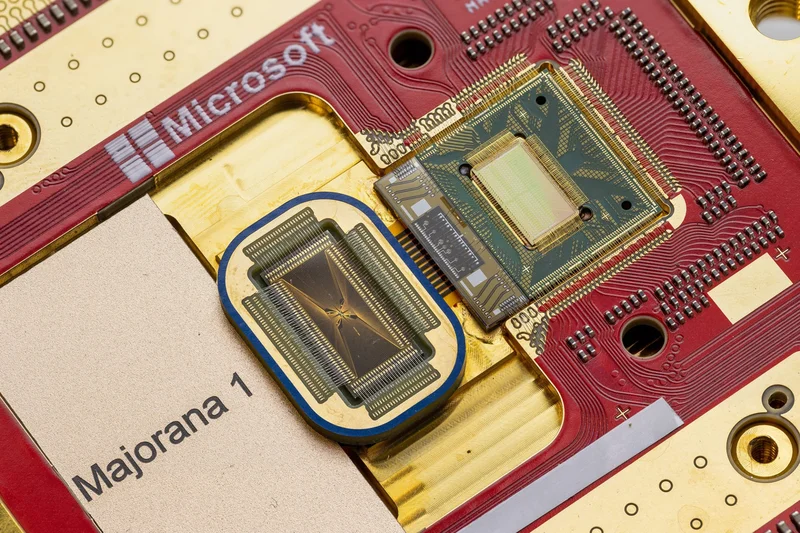
For most of modern history, analog computing has been relegated to a historical footnote. Its fatal flaw was a "century-old problem": a lack of precision. Controlling continuous electrical signals with perfect accuracy is far more difficult than managing the two simple states of a binary switch. The Peking University team appears to have solved this by using a clever two-part circuit built from resistive random-access memory (RRAM) arrays. One part performs a rapid, approximate calculation, and a second circuit iteratively refines that answer until it achieves the precision of a digital processor.
The fact that they achieved this using a commercial manufacturing process is a critical detail, suggesting this isn't merely a laboratory curiosity. It could, in theory, be mass-produced.
Benchmarks and the Fine Print
This brings us back to the 1,000x claim. The performance figures are derived from the chip’s execution of a very specific task: solving matrix inversion problems used in massive multiple-input multiple-output (MIMO) systems (a technology crucial for 6G wireless communication). This is a computationally intensive problem, and one that is perfectly suited to the parallel, simultaneous processing capabilities of an analog architecture. The results are impressive. The chip matched the accuracy of standard digital processors on this task while demonstrating staggering improvements in speed and efficiency.
And this is the part of the analysis that requires a healthy dose of skepticism. I've looked at countless white papers and academic breakthroughs, and a common pattern is to benchmark a new architecture against a legacy one using a task that perfectly highlights the new system's strengths while ignoring its potential weaknesses. The 1,000x figure is real, but it comes with a significant asterisk.
What the paper doesn't tell us is how this chip would perform on the diverse, messy, and varied workloads that comprise modern AI model training. An application like ChatGPT doesn't just perform one type of mathematical operation; it performs millions of different ones. Can this analog design generalize its performance, or is it a highly specialized tool, like a world-class sprinter who can't compete in a decathlon? The data on that is, for now, completely absent. We see a peak performance number, but we have no visibility into the average performance across a suite of real-world tasks. The growth in throughput was about 1,000 times—or, to be more exact, "as much as" 1,000 times, which is a crucial qualifier.
The true breakthrough here may not be the headline number at all. It might be the simple proof that analog computing can be coaxed into delivering digital-level precision. For decades, that was considered impractical, if not impossible. By solving that, the researchers have opened a door that was long thought to be sealed shut. What comes through that door, and how useful it will be, remains an open and critical question.
The Asterisk Is Everything
Let's be clear: the work from Peking University is a genuinely brilliant piece of engineering. Overcoming the precision problem that has plagued analog computing for a century is a landmark achievement. But the narrative that this single chip makes the Nvidia H100 obsolete is a fundamental misreading of the data. The 1,000x performance claim is a best-case scenario achieved on a specialized workload. It’s a marketing figure, not a holistic measure of general-purpose computing power.
The real story isn't that China has built an "Nvidia killer." The real story is that a viable alternative to the digital brute-force paradigm may finally be emerging from the shadows. The future of this technology hinges entirely on its ability to generalize. If its architecture can be adapted to handle the complex and varied tasks of modern AI, it represents a seismic shift. If not, it will remain an incredibly powerful tool for a very narrow set of problems. For now, the digital arms race continues, but for the first time in a long time, there's a new competitor with a completely different rulebook. And that makes things interesting.
Tags: chip
The National Grid Headache: Paying Your Bill, Reporting an Outage, and Getting Customer Service
Next PostCrypto ATMs: What They Are and the Inherent Scam Risk
Related Articles