
Waste Management (WM) Stock Dips After Q3 Earnings Miss: Analyzing the Price Drop and Dividend Outlook
Waste Management’s latest earnings report dropped on October 27th, and the market’s initial reaction was predictable. The stock (NYSE: WM) slipped about 2% in after-hours trading, a reaction captured in headlines like Waste Management (WM) Stock Dips on Q3 Earnings Miss. On the surface, it’s a simple story of a company failing to meet expectations.
But simple stories are rarely the correct ones.
The numbers that flashed across terminals—adjusted EPS of $1.98 versus a consensus of around $2.03, and revenue of $6.44 billion against an expected $6.49 billion—triggered the algorithms and the nervous sellers. Yet, digging into the filing reveals a profound disconnect between the headline narrative and the operational reality. The market saw a miss. I see a finely tuned engine demonstrating record efficiency while navigating a temporary storm.
Deconstructing the Discrepancy
Let’s be precise about the source of the miss. It wasn’t a systemic failure. It wasn’t a sign that people are suddenly producing less trash. The shortfall can be traced almost entirely to two specific, and largely external, factors.
First, the recycling business got hammered. The company reported that average prices for recycled commodities plunged nearly 35% compared to last year. This is a cyclical headwind, not an operational flaw. To put it in perspective, this is like being a world-class farmer who produces a record crop, only to find the global price of wheat has collapsed due to factors far outside your control. You can’t fault the farm’s efficiency for the market’s volatility. This price collapse alone carved out $60 million in year-over-year revenue.
Second, the company’s massive new healthcare division, built from the $7.2 billion acquisition of Stericycle (a deal that closed in late 2024), produced "modestly lower revenue expectations." This is the part that likely spooked investors who are still evaluating that enormous capital outlay. Any sign of weakness in the new prize asset will be magnified. But is a minor softness in revenue during the first year of a complex, industry-defining integration a sign the strategy is failing? Or is it just the predictable friction of merging two corporate giants? The data suggests the latter.
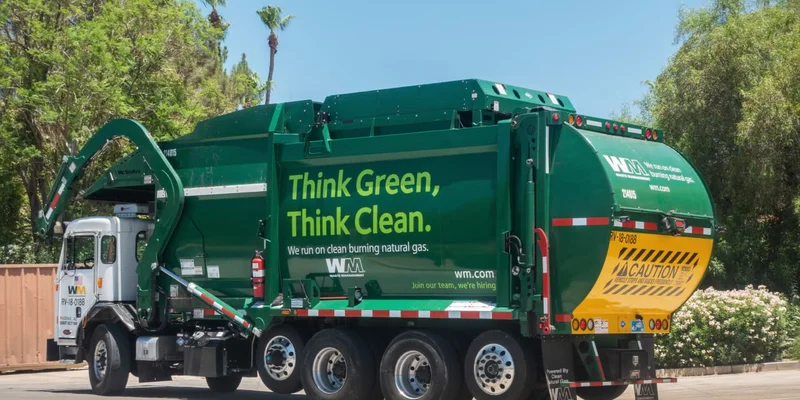
The real question isn't why these two segments underperformed, but rather how the rest of the company performed in spite of them. And the answer to that is where the real story lies.
The Signal in the Noise
While the market was fixated on the revenue line, it seems to have ignored the most important metric in the entire report: margins. Waste Management’s core collection and disposal business—the bedrock of the entire enterprise—achieved an adjusted EBITDA margin of 38.4%. That’s a company record. Let that sink in. In a quarter where they faced significant headwinds, their primary business became more profitable than ever before.
This isn’t an accident. It’s the result of disciplined pricing and operational excellence. The company’s core price increases were 6.0%, with a yield of 3.8%, demonstrating an ability to pass on costs and protect profitability in an inflationary environment. This is the kind of boring, beautiful execution that doesn't make for exciting headlines but builds long-term value. This isn't the chaotic, narrative-driven volatility you see in something like the old `bbby stock`; this is the methodical work of an industrial titan.
And then there's the cash flow. I've looked at hundreds of these quarterly reports, and a double-digit free cash flow jump in the same period you're trimming revenue guidance is an unusual and powerful signal of pricing power. Through the first nine months of the year, operating cash flow jumped 12% to $4.35 billion, and free cash flow rose an even more impressive 13.5% to $2.11 billion.
When CEO Jim Fish said, “Our third quarter results highlight momentum in WM’s earnings growth and free cash flow conversion,” he wasn’t spinning. The data backs him up completely. The company is converting revenue into hard cash more efficiently than ever. This is what funds the reliable `wm stock dividend`, pays down debt from the Stericycle deal, and invests in future growth like renewable natural gas facilities. The `wm stock price today` may have dipped, but the underlying cash-generating machine just got a major tune-up.
Wall Street analysts, for their part, seem to understand this. The consensus rating remains a "Buy," with an average price target hovering around $250, implying a healthy 15-20% upside from the current `wm stock quote`. They’ve trimmed targets slightly to account for the near-term commodity weakness, but nobody is abandoning the ship. They see the same thing the deep-dive data reveals: a resilient business whose long-term trajectory is firmly intact.
The Signal vs. The Noise
My analysis is straightforward: the market reacted to the noise. The noise was a 3-cent earnings miss driven by a cyclical commodity downturn and minor integration friction. The signal—the data that actually matters for the long-term health of the business—is record-high core profitability and surging free cash flow. Waste Management's engine is not only running fine; it's running at peak performance. The slight dip in the `wm stock price` isn't a red flag; it's a misreading of the data by a market obsessed with top-line beats.
Tags: wm stock
The Next Great Stock Market Rally: Why This Week's Signals Point to a New Beginning
Next PostCadence (CDNS) Stock: What's Really Going On and Why It Feels Like a Trap
Related Articles