
JPMorgan's Real Q3 Story: It's Not About the Stock, It's About a Paradigm Shift
On the surface, the numbers are a fortress. JPMorgan Chase, the undisputed titan of American finance, just dropped its third-quarter earnings for 2025, and they look like something carved from granite. Earnings per share of $5.07, shattering Wall Street’s $4.85 estimate. Revenue of $46.43 billion, sailing past the expected $45.47 billion. The stock is up over 30% for the year. By every traditional metric, this is a picture of absolute dominance. You can almost hear the quiet, confident hum of the servers in their data centers, the crisp rustle of money being made while the rest of the world sleeps.
It’s a story of strength, a masterclass in institutional power. They grew their Banking & Wealth Management revenue by a cool 9%, largely fueled by something called "higher net interest income." That’s banking 101—in simpler terms, it’s the age-old profit they make between the interest they pay you on your savings and the much higher interest they charge someone else for a loan. It’s the business model that built empires, funded wars, and shaped the modern world. And right now, that engine is firing on all cylinders.
But then, you read the words from the man at the top, CEO Jamie Dimon. And that’s when the pristine image starts to get a little fuzzy around the edges. When I read his statement, it wasn't the caution that struck me, but the type of caution. He sees a U.S. economy that remains "resilient," but he also warns of a "heightened degree of uncertainty stemming from complex geopolitical conditions, tariffs and trade uncertainty, elevated asset prices and the risk of sticky inflation."
That’s the standard playbook for a CEO, of course. You have to manage expectations. But reading between the lines, I hear something else entirely. I hear the captain of a massive, powerful, unsinkable ship admitting he can’t quite read the weather anymore, because the storms on the horizon look nothing like the ones in his nautical charts.
The Old Maps Don't Work Anymore
Here's the thing that gets my pulse racing: I don't believe the "uncertainty" Dimon is truly grappling with is just about geopolitics or inflation. Those are the known variables, the familiar dragons on the map. The real, fundamental uncertainty is technological. It’s the creeping, exhilarating, and terrifying realization that the very definition of money, value, and trust is being rewritten in real-time by forces far outside the marble halls of Wall Street.
This is the kind of breakthrough that reminds me why I got into this field in the first place. We're witnessing a paradigm shift. Think of it like this: JPMorgan Chase today is like the world’s most successful horse-drawn carriage manufacturer in 1905. Business is absolutely booming. The craftsmanship is impeccable, the logistics are perfected, and every wealthy family wants one. But somewhere, in a handful of garages, you can hear the faint, persistent, and growing rumble of the internal combustion engine. The carriage makers aren't worried yet. Why would they be? Their revenues are at an all-time high.
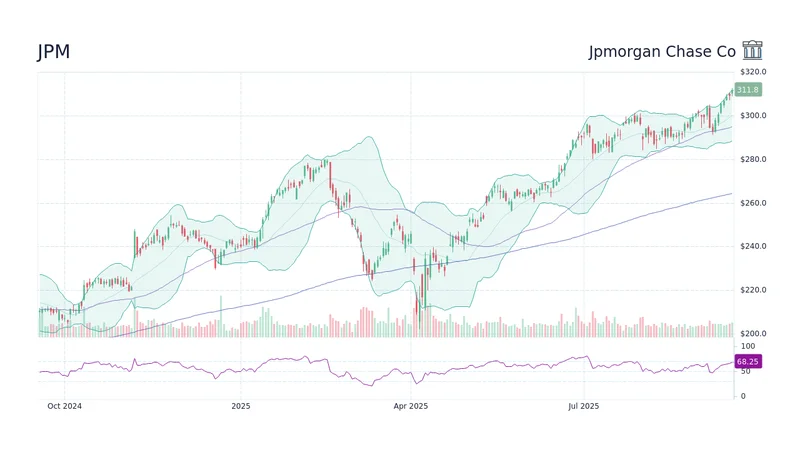
The success of their "net interest income" model is a perfect example. It's a system built on friction, on being the essential middleman. But what happens in a world where value can be transferred peer-to-peer, instantly, with cryptographic certainty? What happens when AI can underwrite loans with more accuracy and less bias than a team of human analysts? What happens when a decentralized autonomous organization—a DAO—can raise and deploy capital more efficiently than a traditional venture firm?
The sheer velocity of innovation in decentralized finance, in AI-driven risk modeling, in frictionless global payments, is creating a new financial operating system for the planet and the old guard is still trying to install updates on a machine running a proprietary, closed-source system from the 20th century. The uncertainty isn't a temporary fog; it's the dawn of a new climate. The question is no longer about navigating the old world better. The question is, will the old ships even float in the new ocean?
A Glimmer of the World to Come
This isn't a eulogy for JPMorgan. Far from it. This institution is a survivor, packed with some of the brightest minds on the planet. They will adapt, acquire, and evolve. But Dimon’s cautious tone is the most important signal in that entire earnings report. It’s an admission that the game is changing. The "heightened uncertainty" is the space where the future is being born.
For you, for me, for every innovator, builder, and dreamer out there, that uncertainty is not a risk—it’s an invitation. It’s the gap between the world as it is and the world as it could be. When the masters of the universe admit they don’t have all the answers, it means the questions are finally open to everyone.
What does a bank look like when it’s not a place, but a protocol? How do you define wealth when assets can be digital, fractionalized, and globally liquid? How do we build systems that are more transparent, more accessible, and fundamentally more equitable than the ones we have today?
The JPM earnings report tells a story of a phenomenally successful present, built on the logic of the past. But the CEO’s own words hint at a future that will be written in a completely different language. It’s a future that won’t be dictated from the top down, but built from the ground up, by a distributed network of creators. The numbers are impressive, yes. But the opportunity they unintentionally reveal is infinitely more exciting.
A Future Written in Code, Not Ledgers
Let’s be perfectly clear. The Q3 numbers from JPMorgan are a snapshot of a world that is already fading. They are a lagging indicator of past dominance. The true leading indicator is Jamie Dimon’s admission of "uncertainty." He's not just talking about the next quarter; he's talking about the next era. For those of us who believe technology can build a better world, that uncertainty is the sound of the starting gun. The old guard sees risk. I see the greatest creative and economic opportunity of our lifetime. The game is on.
Tags: jpm stock
Costa Rica's World Cup Qualifier: The Schedule, How to Watch, and If It Even Matters
Next PostRichard Branson's Virgin Atlantic Installs New CEO: The Announcement, Rationale, and What Comes Next
Related Articles