
The Emirates Data Deep Dive: Analyzing Flight Costs, First Class vs. Business, and the Qatar Comparison
The A380 Anomaly: Decoding Emirates' High-Stakes Capacity Gamble
When most people think of Emirates, they picture premium cabins, cocktail bars at 40,000 feet, and a brand built on luxury. The marketing is effective. But behind that veneer lies a far more pragmatic, and frankly, more interesting operation. Data from Cirium for the upcoming winter 2025/2026 season exposes the airline’s other strategy: a high-volume, mass-market machine built on the back of a very specific aircraft—the two-class, 615-seat Airbus A380.
This isn't the Emirates of champagne and private suites. This is the Emirates of pure, unadulterated passenger volume. The airline operates 15 of these high-density A380s, each configured with a mere 58 business class seats and a staggering 557 economy seats. For context, that’s more economy passengers than any other A380 operator fits on their entire aircraft. It’s a “stack them high, sell them cheap” philosophy that seems almost antithetical to the carrier’s premium image.
Looking at the winter schedule (from October 1, 2025, to January 30, 2026), the scale of this operation becomes clear. A full breakdown of Where Emirates Will Fly Its Very High-Capacity Airbus A380s This Winter shows Emirates has planned over 20,000 flights using this configuration, offering more than 10 million seats. This isn’t a niche strategy; it’s a core pillar of their business model, designed to funnel immense numbers of people through their Dubai super-hub. The numbers tell a story of a business that has perfected the art of leveraging a unique asset to its absolute limit. But they also reveal a critical dependency on an aircraft that has no successor.
The Logic of Unmatched Density
The deployment of these high-capacity jets is a masterclass in operational efficiency. The flagship route, Dubai (DXB) to London Heathrow (LHR), will see 738 one-way flights this winter. At a severely slot-constrained airport like Heathrow, using a 615-seat aircraft is a form of arbitrage. Emirates can satisfy enormous demand without needing to acquire additional, and fantastically expensive, landing slots. Each flight is doing the work of nearly two smaller jets. It’s the same logic applied to other major routes like Bangkok, Sydney, and Manchester.
What’s more revealing are the outliers in the data. The schedule includes both the airline’s longest route—the 8,810-mile trek from Dubai to Auckland—and a handful of surprisingly short hops to destinations like Amman, Mumbai, and Jeddah. Flying a superjumbo on a 1,000-mile flight seems like overkill, but it points to the aircraft’s true function: it’s a strategic tool for deploying capacity. It's like a cargo ship in a world of speedboats. Where Emirates identifies a massive, concentrated demand for economy travel, whether for leisure, VFR (visiting friends and relatives), or religious pilgrimage, it deploys this specialized asset. The route distance is almost a secondary consideration to the primary goal of moving a huge volume of passengers.
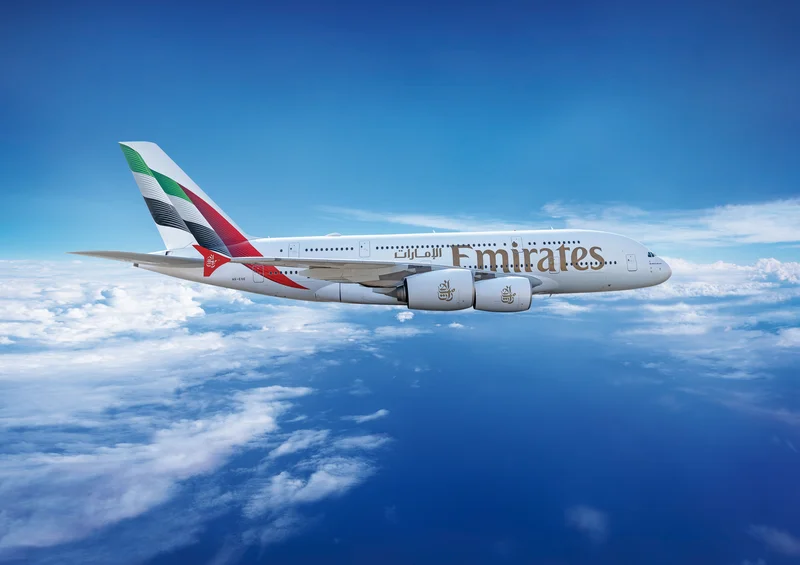
This strategy is a double-edged sword. On one hand, it has allowed Emirates to build its Dubai hub into an unrivaled global crossroads. The model works because the A380 allows them to connect virtually any two points on the globe with a single stop, feeding massive waves of passengers from all corners of the network into these high-capacity trunk routes. I've looked at hundreds of these network filings over the years, and the sheer concentration of capacity in a handful of city pairs is unusual. It highlights just how dependent the entire system is on these specific airframes.
The Inescapable Math of Replacement
Herein lies the problem. The A380 program is over. While Emirates will fly its fleet for many years to come, there is no new-build replacement on the horizon. The designated successor for large, long-haul aircraft is the Boeing 777X, of which Emirates is the largest customer (with orders for 170 of the -9 variant and 35 of the smaller -8). The issue is one of simple arithmetic.
A two-class Boeing 777-9 is projected to seat between 414 and 426 passengers. Compared to the 615-seat A380, that represents a capacity drop of around 30%—to be more exact, it's a 30.7% reduction per frame if we use the 426-seat figure. To match the passenger volume of just two high-density A380 flights, Emirates would need to operate three 777-9s. To replace the capacity of its 15 high-density A380s, it would need to acquire and operate roughly 22 777-9s, requiring a third more flights, a third more crew, and, most critically, a third more airport slots.
And this is the part of the analysis that I find genuinely puzzling. The public narrative from both the airline and the manufacturer tends to gloss over this fundamental capacity gap. How does Emirates plan to maintain its passenger volume through Heathrow, for example, when its primary tool for circumventing slot limitations is phased out? Will they be forced to reduce frequency, raise prices, or divert traffic? The data doesn't provide an answer, but it certainly frames the question.
This isn't just about replacing one plane with another. It's about replacing a unique capability. The high-density A380 is a specialized tool, like a custom-forged wrench designed for a single, critical bolt on which the entire machine depends. Once that wrench is gone, you can try to make do with smaller, standard-issue tools, but the job will be slower, less efficient, and far more costly. The winter 2025/2026 schedule feels less like a routine plan and more like the high-water mark of a business model living on borrowed time.
A Ticking Clock Measured in Seats
My core takeaway from this data is simple: Emirates has built a formidable global network by leveraging an asset that is, for all intents and purposes, irreplaceable. The winter 2025/2026 flight plan isn't just a schedule; it's a portrait of peak A380 dependency. The airline's entire hub-and-spoke model is predicated on the economics of this specific, high-density aircraft. While the premium cabins get the headlines, the real engine room is the 557-seat economy cabin of these 15 jets. The transition to the 777X isn't an upgrade; it's a mathematical problem that threatens the very foundation of the airline's volume-based strategy. The clock is ticking, and every flight this winter is one tick closer to a major strategic reckoning.
Tags: emirates
CoinMarketCap: Live Prices, Market Cap & Charts
Next PostAST SpaceMobile's Breakthrough: Why Its Stock is Soaring and What It Means for the Future of Connectivity
Related Articles