
TSM Stock Analysis: What Its Price Tells Us About the NVDA & AMD Rivalry
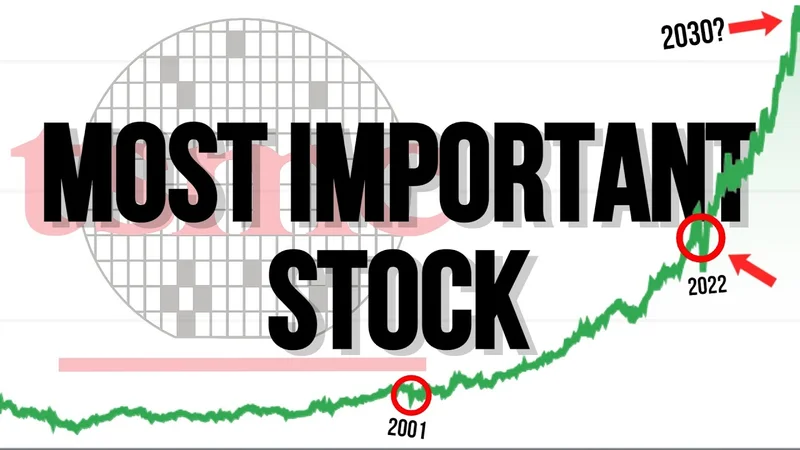
The numbers coming out of Taiwan Semiconductor (TSM) are, to be blunt, staggering. As of early October, the stock has climbed 18.2% in a single month. Year-to-date, it’s up nearly 50%. The current TSM stock price is hovering around $302, pushing past its 52-week high and leaving competitors in the dust. While NVIDIA (NVDA) managed a respectable 11.5% gain and AMD saw an 8.8% bump, TSM outpaced them all.
This isn't a rally built on pure speculation. The fundamentals are pristine. Second-quarter revenues jumped 44% year-over-year to over $30 billion. Earnings per share shot up 61%. Management felt confident enough to raise full-year 2025 revenue growth guidance to 30%, a significant jump from their earlier mid-20s projection. This bullish outlook is echoed by analysts, with some outlining 3 Reasons You'll Regret Not Buying Taiwan Semiconductor Stock Before 2025 Is Over - The Motley Fool.
On paper, this is the perfect growth story. TSM is the indispensable foundry at the heart of the AI revolution, fabricating the silicon brains for clients like NVIDIA, Marvell, and Broadcom. Its most advanced nodes, the 3-nanometer and 5-nanometer technologies, now account for 58% of its wafer sales. The company’s AI-related revenue, which tripled in 2024, is on track to double again this year.
So, here is the central question that my analysis keeps returning to: If TSM is the foundational layer upon which the entire AI boom is built, why does the market refuse to value it like its high-flying customers? Why is the undisputed king of the castle trading at a discount?
The Engine Room of the AI Revolution
To understand TSM, you have to understand its position in the supply chain. It’s not just another chip company; it’s the master artisan. TSM doesn’t design the graphics cards or the server processors. Instead, it provides the one thing no one else can produce at scale: the most advanced manufacturing process on the planet. Think of it less as a competitor in the race and more like the company that builds the racetrack, paves the asphalt, and sells the high-octane fuel to every single team. Whether the winner is an NVDA stock or an AMD stock, TSM collects its toll.
This dominance is reflected in its technical roadmap. The company is on schedule to launch its 2-nanometer chip in 2025, a node that promises a 25-30% improvement in power efficiency. After that comes the A16 node in 2026. This isn't just incremental progress; it's a relentless march that keeps its customers locked into its ecosystem. To fund this, capital expenditures are set to swell to between $38 billion and $42 billion in 2025—to be more exact, that’s up from $29.8 billion in 2024—with the vast majority dedicated to staying at the bleeding edge.
The financial results are a direct consequence of this technological monopoly. The growth isn't just in AI. While that segment is the star, the sheer demand for advanced silicon across all sectors buoys the entire enterprise. Management’s forecast for third-quarter revenue is between $31.8 billion and $33 billion, indicating that the momentum isn’t slowing.
Given this data, a premium valuation would seem not only justified but logical. The company is executing flawlessly, holds a near-monopolistic position in a critical industry, and is the primary beneficiary of the largest technological shift in a generation. And yet, when you look at the multiples, the story gets complicated.
A Price Tag for Geopolitical Risk
Here is the discrepancy. TSM trades at a forward 12-month price-to-earnings multiple of 26.99. The sector average is 29.4. Its key customers and competitors trade at much richer valuations: Broadcom (AVGO) is at 37.96, NVIDIA is at 33.30, and AMD is at 30.29. The market is pricing the premier foundry in the world more cheaply than the companies that depend on it for their very existence.
What explains this gap? The market is pricing in risk. It’s a quiet, consistent discount that acts as a numerical acknowledgment of two major headwinds.
The first is operational and quantifiable. TSM is aggressively expanding its global footprint to mitigate geopolitical concentration, with massive new fabs planned for Arizona, Japan, and Germany. The U.S. investment alone is a colossal $165 billion. But this diversification comes at a cost. Management has been transparent that these new facilities will be more expensive to operate than their Taiwanese counterparts, projecting a drag on gross margins of 2-3 percentage points annually for the next three to five years. I've analyzed dozens of semiconductor company filings, and it's rare to see a management team so explicitly quantify a future margin drag. It's both transparent and a clear warning sign that the cost of security is steep.
The second headwind is the one that truly defines the stock's narrative: geopolitical tension. The company is based in Taiwan, and the persistent friction between the U.S. and China creates a layer of unquantifiable risk that hangs over every earnings report and every stock price update. No amount of financial modeling can accurately price a black swan event. What is the correct discount for that kind of existential uncertainty? Is it 10%? 20%? 30%?
This is the tightrope TSM walks. On one side, you have near-perfect operational execution and technological dominance. On the other, you have a clear, calculated margin hit from expansion and a vague but terrifying geopolitical overhang. The stock’s recent rally suggests that, for now, investors are more focused on the former. They see the 44% revenue growth and the doubling of AI sales and are willing to look past the risks. But are they correctly pricing the probability of the latter? Or is the fear of missing out on the AI boom simply overriding classical risk assessment?
The Market's Geopolitical Discount
Ultimately, the TSM stock price is a mathematical expression of the market’s anxiety. The company’s fundamentals scream for a valuation that would place it among the most expensive tech stocks in the world, right alongside titans like Amazon (AMZN) or Tesla (TSLA). Its performance metrics are, in many ways, superior. Yet it trades at a discount because it carries a risk that cannot be hedged. The stock isn't "cheap" because the business is flawed; it's priced this way because the market has attached a permanent, floating risk premium to its geography. The current 50% year-to-date rally isn't the market suddenly discovering TSM's quality. It's the market recalibrating its tolerance for that risk, deciding that the potential reward from AI dominance is finally compelling enough to outweigh the ever-present threat. The only question is whether that calculation will hold.
Tags: tsm stock
APLD Stock: Why It's More Than Just Another AI Stock
Next PostPlasma: What It Is and Why It's the Key to Our Future
Related Articles