
So, a rock the size of Manhattan is about to do a drive-by on Mars, and the...
2025-10-04 24 interstellar comet 3i atlas
Let’s get one thing straight. If an alien spaceship or a civilization-ending comet were actually hurtling toward Earth, you wouldn't find out from a screenshot of a New York Post article on X. You’d know because the internet would be down, your power would be out, and the last thing you'd hear would be the faint sound of every world leader simultaneously trying to get the last seat on a bunker-bound helicopter.
But that’s not how we do things in 2025, is it?
Instead, we get a week-long global panic attack fueled by grifters, bots, and people who think "doing their own research" means watching a 10-minute YouTube video with robot narration. The arrival of 3I/ATLAS, our third-ever confirmed interstellar visitor, should have been a moment of collective awe. A genuine, bona fide piece of another solar system, right here in our backyard. Instead, it became a clown show.
It all started, as these things always do, with a piece of primo clickbait. The New York Post ran a breathless headline about a “‘Massive’ comet” that “could be alien tech.” That was all the internet needed. The starter pistol for the digital stampede had been fired.
Suddenly, my feed was clogged with it. Screenshots of the article, passed around like holy scripture. Some guy named Steven Greenstreet breathlessly asked, “Why aren’t more people talking about this?!?!”—a question that is always, without fail, posted by people talking about it to millions of other people. Another account, "Dr. Disclosure," connected the comet to a routine meeting of US generals, racking up half a million views from people who apparently believe military strategy is dictated by whatever random space rock is trending that day.
It was a masterclass in manufactured hysteria. They had fake quotes from physicist Michio Kaku, claiming the comet was on a "reconnaissance mission, possibly with hostile intent." The image used, offcourse, was from an unrelated interview months before anyone even knew 3I/ATLAS existed. But who needs context when you've got a good story? This ain't about facts; it's about vibes.
The whole spectacle is like watching a city panic because someone saw a weird cloud and decided it was Godzilla. Scientists at NASA and the ESA are calmly trying to explain the principles of atmospheric moisture, but everyone is too busy looting stores for anti-kaiju spray and arguing about whether Godzilla is vulnerable to tactical nukes. They expect us to believe this, and honestly...
What does it say about us that we'd rather invent a Hollywood disaster plot than listen to the people who actually have billion-dollar telescopes? Are we so desperate for drama that we'll take a blurry picture and a conspiracy theory over a clear statement from the European Space Agency?
While the internet was busy casting Bruce Willis for the inevitable movie adaptation, actual scientists were, you know, doing science. And what they found was infinitely more interesting than some cheap alien invasion trope.
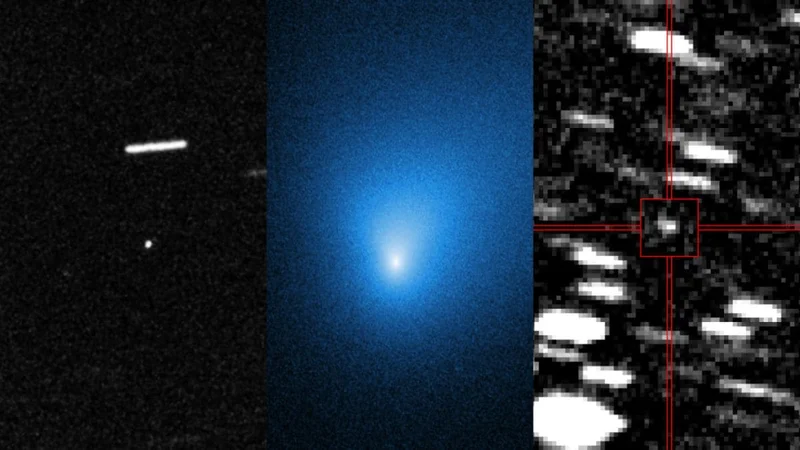
First, the "threat." Let's put this to bed. At its closest point to us, 3I/ATLAS was 270 million kilometers away. That’s about 1.8 times the distance between the Earth and the Sun. You are in more danger of being struck by lightning while winning the lottery on your birthday than you are from this comet. NASA and the ESA both issued statements basically saying, "Everyone please calm down, it's not going to hit us." But those posts don't get the same engagement as "GENERALS ARE GATHERING!"
This is a bad sign for our collective intelligence. No, 'bad' doesn't cover it—this is a five-alarm dumpster fire of critical thinking. We've got this incredible scientific opportunity, a literal message in a bottle from a distant star system, and half the population is treating it like a threat. It’s like being handed a pristine, unopened letter from a lost civilization, and instead of trying to translate it, everyone starts screaming that the envelope is on fire and will burn the whole planet down.
The real story is the observation campaign. Because the comet swung behind the sun from our perspective in September, ground-based telescopes lost sight of it. So what did we do? We used our goddamn space robots. ESA’s Mars orbiters were pointed at it in early October. NASA's Psyche mission got a look. And the Jupiter Icy Moons Explorer (JUICE) is getting ready for the main event in November, when the comet is at its most active. This is a coordinated, international effort to learn everything we can from a fleeting visitor. It’s humanity at its best—curious, ingenious, collaborative.
But yeah, sure, let's focus on the blurry JPEGs and the guy who thinks it's a "Messiah Crew" mission. That's way more productive.
Here’s the kicker: 3I/ATLAS is genuinely weird. Just not in the way the conspiracy crowd wants it to be.
Early analysis of the light coming from the comet's coma—the gassy cloud around its nucleus—found some puzzling stuff. For one, it has an "extreme" and unusual ratio of iron to nickel. Scientists are still scratching their heads over how those heavy metals are getting vaporized into the coma when the comet is still so far from the sun. The temperatures just shouldn't be high enough. Interstellar Comet 3I/ATLAS Found To Have "Extreme Abundance Ratio" Of Iron And Nickel
Then there's the carbon. Data from the Webb telescope shows it's packed with carbon dioxide but has very little carbon monoxide. This suggests it was formed in a very carbon-rich environment, and some scientists even speculate it could be over 7 billion years old—older than our own solar system. Is 3I/ATLAS an Interstellar Messenger? New Findings Debunk Alien Rumors but Reveal an Ancient, Carbon‑Rich Comet
This is the real juice. This is the stuff that matters. Does the chemistry of this comet suggest that the building blocks of planets are common across the galaxy? Or does it point to exotic ingredients from a star system completely unlike our own? These are the questions that push our understanding of the universe forward. They're a hell of a lot more profound than asking if it has laser cannons.
Even Avi Loeb, the Harvard astronomer who famously suggested our first interstellar visitor, ʻOumuamua, could be alien tech, has weighed in. But even his speculation is grounded in physics and orbital mechanics, not out-of-context screenshots. He’s asking interesting, if provocative, questions. He’s not shouting about generals in a bunker. There’s a world of difference.
In the end, the story of 3I/ATLAS isn't about a comet. It's about us. It's a perfect snapshot of a culture that has lost its ability to distinguish between a genuine wonder and a cheap thrill. We are drowning in information but starving for wisdom. We have the collective knowledge of humanity in our pockets, and we use it to scare ourselves with ghost stories because the truth feels too slow, too complicated, and doesn't offer the same dopamine hit as a good old-fashioned panic. The real interstellar messenger here wasn't the comet; it was the reflection it showed us of ourselves. And frankly, it wasn't a pretty sight.
Tags: interstellar comet 3i atlas
Related Articles
So, a rock the size of Manhattan is about to do a drive-by on Mars, and the...
2025-10-04 24 interstellar comet 3i atlas