
ASML's 2026 Growth Projections: The China Sales Warning vs. Long-Term Forecasts
ASML is a fascinating case study in market dynamics. It's the sole producer of the extreme ultraviolet (EUV) lithography systems required to manufacture the world's most advanced semiconductors. This technological monopoly makes it a linchpin of the entire global tech ecosystem, from the foundries of TSMC and Samsung to the AI ambitions of Nvidia and AMD. Its stock performance reflects this unique position, with a rally of nearly 40% in 2024 driven by the insatiable demand for AI-related chips.
But as we approach its October 15th earnings report, the company finds itself at the epicenter of two opposing forces. On one side, you have a chorus of analysts projecting a bright future fueled by sustained AI demand and technological advancement. On the other, a rapidly escalating trade war between the US and China threatens to throttle the very supply chains ASML depends on. The stock is currently consolidating around €828, holding above its key moving averages but clearly sensing the tension. The question for any serious investor isn't just about the company's Q3 numbers; it's about which of these powerful narratives will ultimately dictate its trajectory.
The Analyst Consensus: A Chorus of AI-Fueled Optimism
If you only read the analyst reports, you'd be forgiven for thinking ASML's path forward is a straight line up. The sentiment is overwhelmingly bullish. JPMorgan has set the high-water mark with a $1,175 price target, citing anticipated AI demand and an improved spending outlook. Susquehanna isn't far behind at $1,150, pointing to sustained demand for EUV systems. Goldman Sachs and Morgan Stanley echo this optimism, with targets of €935 and €950 respectively, both highlighting ASML as a primary beneficiary of the AI boom and the eventual recovery in the memory market.
The common thread is clear: AI is the engine, and ASML provides the critical components for that engine. Analysts expect revenue and earnings per share to grow 14% and 25% this year, with a projected EPS CAGR of 16% through 2027. This narrative is supported by the company’s recent performance. After a sluggish start to 2024, ASML has posted double-digit growth in both net sales and EPS for the past four quarters. The stock is up approximately 20% year-to-date—to be more exact, 20.4% as of October 14th.
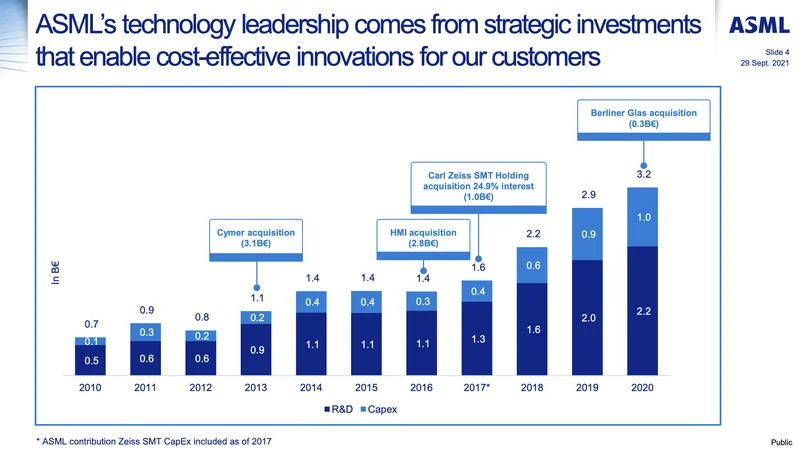
This is the story the market wants to believe. It’s clean, logical, and rooted in a powerful secular trend. ASML's monopoly on EUV and its upcoming High-NA systems create a formidable moat. But how robust are these financial models against a sudden, politically motivated supply chain disruption? Are they properly pricing in a scenario where China's countermeasures go beyond simple licensing and create genuine bottlenecks? I’ve looked at hundreds of these filings, and the disconnect between the pristine financial projections and the chaotic geopolitical reality is unusually stark here.
Geopolitics: The Unpriced Risk Factor
While analysts focus on demand curves and earnings multiples, the geopolitical landscape is deteriorating rapidly. On October 9th, Beijing implemented tighter export controls on rare earth elements, requiring licensing for any product containing more than 0.1% of Chinese-origin materials. This isn't a subtle move; it's a direct shot across the bow aimed at the semiconductor and AI industries. This comes as President Trump threatens 100% tariffs on Chinese imports, a move that would undoubtedly trigger severe countermeasures from Beijing.
This is where the bull case for ASML starts to look fragile. The company is already barred from selling its most advanced EUV systems to China and faces restrictions on its higher-end DUV systems. These latest Chinese export controls (specifically targeting materials used in manufacturing) create a new layer of operational risk. ASML is a ship captain with a perfect map of the stars—its long-term technology roadmap—but seems to be sailing directly into a hurricane forming on the horizon. The analysts are all admiring the map; few seem to be checking the weather radar.
The stock’s recent price action reflects this anxiety. After hitting a high of €897 in early October, it has pulled back to the €828 level, testing its 20-day simple moving average. While it remains above longer-term support levels like the 50-day SMA at €722, the momentum has clearly stalled. The market is hesitating, caught between the long-term promise and the short-term peril. This isn’t just standard pre-earnings jitters; it’s the market attempting to price in a risk factor that doesn't fit neatly into a spreadsheet. What happens if a key component for an EUV machine is suddenly held up by a new licensing requirement in China? The downstream effects on TSMC, Intel, and the entire AI ecosystem would be immediate and severe.
A Tale of Two Timelines
My analysis suggests that we are looking at two fundamentally different investment theses operating on separate timelines. The long-term thesis, favored by Wall Street, is that ASML's technological dominance is insurmountable. Over a five-to-ten-year horizon, this is almost certainly correct. But the short-term thesis is a bet on geopolitics. The risk of an earnings miss or, more likely, a downward revision to future guidance due to supply chain uncertainty or demand destruction from the trade war is, in my view, significantly higher than the consensus believes. Buying the stock days before an earnings call in this environment isn't an investment in technology; it's a speculation on the next move from Washington and Beijing. And that's a variable no financial model, not even an ASML Holding Stock Forecast 2025–2030, can accurately predict.
Tags: asml stock
ChainOpera AI's Surge and Collapse: Deconstructing the Price Action and Tokenomics
Next PostThe 'Bless' Grift: From Crypto Pumps to Bibles Missing Amendments
Related Articles