
Arm's Post-Earnings Surge: A Data-Driven Look at its Valuation and Future Forecast
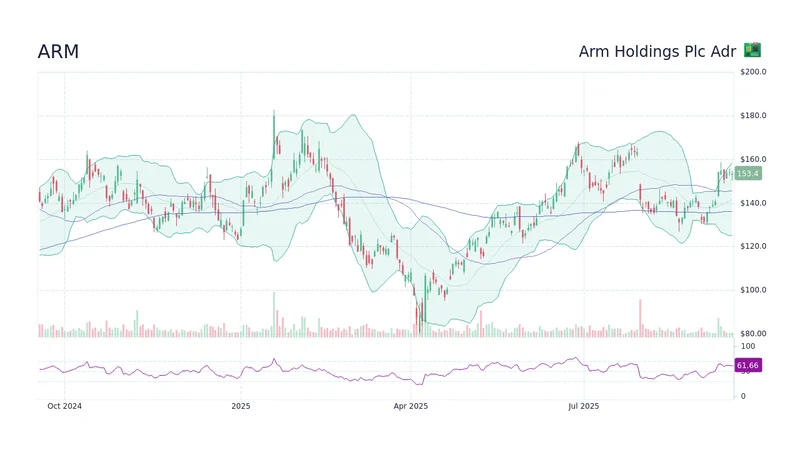
The price chart for Arm Holdings (NASDAQ: ARM) is a fascinating study in market psychology. On any given day, it can surge on a partnership announcement or dive on profit-taking. As of mid-October, the stock is hovering around $155, up roughly 23% year-to-date after a volatile ride that saw it peak near $183. The chart looks less like a reflection of fundamental value and more like an EKG readout during a stress test.
The conventional narrative is simple: Arm is an essential AI play. Its designs are the bedrock of the mobile world and are now crucial for on-device AI, data centers, and automotive tech. But when I look at the numbers, a significant discrepancy emerges between the story being told and the financial reality of the business. The market is pricing Arm for a future that its own business model seems ill-equipped to deliver, creating a valuation that feels untethered from its operational core. The question isn't whether Arm is a good company—it is. The question is whether its stock price reflects the company that exists or one that lives only in a pitch deck.
The Royalty Engine vs. The Rocket Ship
To understand the disconnect, one must first appreciate Arm's business model, which is both its greatest strength and its primary constraint. Arm is often called the "Switzerland of semiconductors" for a reason. It doesn't manufacture or sell chips; it designs the fundamental architecture—the blueprints—and licenses that intellectual property to everyone from Apple to Qualcomm. This model is magnificent for profitability. With no manufacturing costs, Arm boasts gross margins around 97%, a figure that would make nearly any other company weep with envy.
Revenue comes from two streams: upfront licensing fees for new designs and a long tail of royalties on every chip sold that contains its tech. The company is now pushing to increase its take, with its newer v9 architecture commanding a 5% royalty versus 3% on older tech. This is a solid, defensible business that has given Arm a near-monopoly in the smartphone market, where it holds an estimated 99% share.
But here is the core of the issue. This is the model of a utility, not a rocket ship. Its primary market, smartphones, is mature, with global shipments growing a mere 1% last quarter. While Arm is making inroads into data centers, automotive, and IoT, these are incremental gains. Analysts project annual revenue growth of around 20-22%—to be more exact, some forecasts pin the rate at 21.5% through 2028. That is strong, respectable growth for a company of its scale.
It is not, however, the kind of explosive, paradigm-shifting growth that justifies its current valuation. The stock trades at well over 150 times forward earnings, a multiple that dwarfs even Nvidia's (which trades closer to 60-70x forward EPS). Nvidia sells the actual shovels—the GPUs—in the AI gold rush, capturing massive revenue from each unit. Arm, by contrast, collects a small, albeit high-margin, tax on those shovels. Can a royalty business, even a dominant one, ever grow fast enough to close that valuation gap?
The SoftBank Distortion Field
If Arm’s fundamentals don't explain the stock's price, what does? The answer lies not within Arm, but with its majority owner, SoftBank. The Japanese conglomerate still owns approximately 90% of the company, leaving a tiny public float of just 10%. This scarcity acts as a powerful accelerant. Any positive news or shift in sentiment can cause a dramatic price spike because there are simply not enough shares to meet demand, a key factor in the recent Arm Holdings’ AI-Powered Rally: Stock Surges Amid SoftBank’s Big Bet and Tech Partnerships.
This structure has been weaponized by SoftBank itself. Just recently, it was reported that SoftBank is arranging another $5 billion margin loan using its Arm shares as collateral. This is part of a broader strategy to leverage its stake in Arm to fund its other, far more speculative AI ventures, like its investments in OpenAI. SoftBank's total loans secured by Arm stock could now reach a staggering sum (potentially up to $18.5 billion).
I've looked at hundreds of these kinds of financial structures, and this particular arrangement creates a dangerous feedback loop. SoftBank needs Arm's stock to remain elevated to back its massive borrowing and fuel its AI ambitions. This gives it every incentive to promote the "Arm as an AI juggernaut" narrative, irrespective of the underlying royalty-based financials. The stock is no longer just a claim on Arm's future earnings; it's a critical financing tool for its parent company's entire ecosystem.
This creates a profound risk for public investors. The stock's valuation is being artificially supported by a constrained supply and the strategic needs of a single, dominant shareholder. What happens if SoftBank's other bets sour and it faces a margin call? The very entity holding the share price up could be forced to sell, flooding the market and cratering the stock. The fate of an ARM investor is now inexorably linked to the success of SoftBank's entire venture portfolio. How many shareholders have accurately priced that externality?
A Price in Search of a Narrative
My analysis leads me to a clear conclusion. Arm Holdings is a phenomenal business with a nearly unassailable market position in mobile computing and a logical path to growth in adjacent markets. It is, in essence, a high-quality, wide-moat utility for the digital age.
The problem is that ARM, the stock, is being traded as something else entirely. It's being valued as a speculative, hyper-growth AI entity, a narrative fueled by a low-float structure and the financial necessities of its majority owner. The market has priced in a future of exponential growth that the company's own steady, royalty-based business model is not designed to achieve. Buying ARM at these levels isn't a bet on the company's brilliant engineering; it's a bet that this valuation disconnect can sustain itself, raising the classic ARM Stock Surge: Buy or Wait? question for investors. And in the long run, the numbers rarely support a story forever.
Tags: arm stock
Oklo's Nuclear Vision: What's Driving the Hype and What It Means for Our Energy Future
Next PostJPMorgan's Record Quarter: Why It's a Glimpse Into a New Economic Era
Related Articles