
Gold Price Surpasses $4,000: A Breakdown of the Spot Price Per Ounce & Gram
Gold just crossed $4,000 an ounce. This isn’t the time to celebrate—it’s time to scrutinize the numbers.
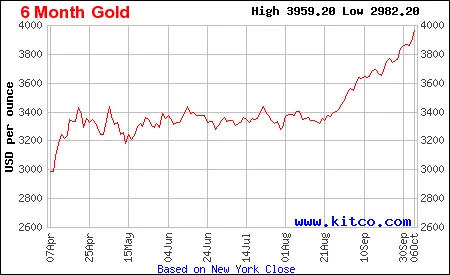
The screens all flashed green on Tuesday. Gold futures (GC=F), the asset classes’ ancient, stoic grandfather, briefly touched $4,007.90. The financial news outlets, of course, framed it as a victory lap, a moment investors have been "eagerly anticipating," with headlines like Gold price today, Tuesday, October 7, 2025: Gold opens at record high, surpasses $4,000. My inbox is already filling with breathless pitches for "affordable" ways to get in on the action before the metal becomes "totally out of reach."
But when I see a number like that, I don't feel euphoria. I feel a professional obligation to be skeptical. A 50% run-up in a single year for an asset that is supposed to be a "stabilizer" isn't a sign of health; it's a symptom of a fever. The narrative is that geopolitical instability, a weaker dollar, and central bank appetite are forging a new, permanently high plateau for gold. The data, however, suggests we're standing on a peak, and the air is getting dangerously thin.
The Anatomy of a Parabolic Move
Let's be precise about the ascent. The price of gold today isn't just up; it's accelerating. The move to $4,000 represents a one-year gain of over 50%—to be more exact, 50.4% from its opening price on October 7, 2024. That’s a staggering jump, far outpacing its historical average annual return. For context, this kind of rally is more reminiscent of what you’d expect from the Bitcoin price today, not a multi-trillion dollar asset held in reserve by the world’s most conservative financial institutions.
The bull case rests on a familiar set of drivers. Goldman Sachs has revised its forecast upward, now calling for $4,900 by the end of 2026. They point to central bank buying (a legitimate and observable trend) and gold’s function as a safe haven amid trade tensions. These are valid inputs. But are they sufficient to justify the current valuation? Or have they simply become the convenient, backward-looking explanation for a price chart that has gone vertical?
This is where my analysis diverges from the headlines. The story of what is the price of gold today is no longer about fundamentals. It’s about momentum. The surge from $3,000 in March to $4,000 now has been fueled by an influx of speculative capital—retail investors, ETFs, and discretionary funds chasing performance. This creates a feedback loop: rising prices attract more buyers, which pushes prices higher still. It’s a powerful engine, but it burns through fuel at an unsustainable rate. The critical question nobody seems to be asking is: what happens when the momentum stalls?
A Necessary Dose of Historical Context
The current narrative suffers from a severe case of recency bias. We’re so focused on the spot price of gold today that we’re ignoring the asset’s multi-decade cycles of boom and brutal bust. This isn't gold's first rodeo. The run-up feels like a modern re-staging of the 1970s, when gold rose nearly 850% in a decade. What followed that parabolic move? A punishing, 20-year bear market that saw the metal fall 82% from its peak.
I've looked at hundreds of these long-term commodity charts, and the pattern is almost always the same: a parabolic rise fueled by a compelling narrative, followed by a multi-decade reversion to the mean. What I find genuinely puzzling is the collective amnesia that seems to grip the market at the peak of every cycle. The period from February 2001 to today has seen gold gain 591%, a historic run by any measure. To expect that rate of return to continue indefinitely is to ignore the fundamental law of financial gravity.
This is the opportunity cost that the gold bugs never mention. While gold delivered an average annual return of 7.9% between 1971 and 2024, the stock market returned 10.7%. Gold’s entire purpose in a portfolio, according to its proponents, is to act as a diversifier and a store of value. It’s insurance. But right now, people aren't buying it as insurance; they're buying it like a lottery ticket. They're paying an incredibly high premium for a policy right after the disaster has already struck, hoping for another one to hit right away.
This is the core discrepancy in the current market. Gold is being marketed as both a safe-haven asset and a high-growth speculation. It cannot be both. Its value as a stabilizer is predicated on its lack of correlation with risk assets. But in this feverish environment, it has become the risk asset.
Deconstructing the "Affordable" Pitch
The most telling sign of a market top is the way an asset is sold to the public. As the price of gold today per ounce breaches $4,000, the marketing has shifted from "protection" to "participation." We're flooded with articles like Gold's price breaks record $4,000 per ounce. Here's how to get affordably invested now., which explain how to get "affordably invested" through fractional bars, dollar-cost averaging, and gold IRAs.
One article advises that "it makes sense to get started now, before the next price rise pushes this unique asset totally out of reach." This isn't financial advice; it's a masterclass in manufacturing Fear of Missing Out (FOMO). The logic is fundamentally flawed. "Affordable" doesn't mitigate risk. Buying a quarter-ounce of an asset near its all-time high carries the same downside percentage risk as buying a full kilobar. The only thing that's smaller is the nominal dollar amount of your potential loss.
This entire framing is a methodological sleight of hand. The articles highlight the recent surge while conveniently burying the data on long-term underperformance and historical crashes. They present analyst price targets (which are, at best, educated guesses) as certainties. Who does this narrative serve? It certainly benefits the brokers, the ETF providers, and the custodians of gold IRAs who collect fees on every transaction, regardless of whether their clients make or lose money. For the retail investor arriving now, it’s a far more perilous proposition.
The Gravitational Pull of the Mean
So, what is the price of gold today really telling us? It’s not signaling the start of a new monetary era. It’s a warning flare. The number $4,000 is psychologically potent, but analytically, it’s just a data point indicating that we are extended, overbought, and saturated with speculative interest. The risk now is not in missing the next 10% move up; it’s in being fully exposed to the inevitable 30% or 40% correction when the narrative shifts and the hot money flees. The story of gold is cyclical, and history shows that buying into the euphoria at the peak is a strategy with a dismal track record. This isn't a plateau. It's a precipice.
Tags: price of gold today
Oracle's Trillion-Dollar AI Push: What This Means for the Future of AI
Next PostTrilogy Metals' Sudden Surge: A Data-Driven Look at the Government's 10% Stake
Related Articles