
AMD Stock Price: The Nvidia Comparison and Its Place in the Market
# AMD's Identity Crisis: Why a Win Against Intel Feels Like a Loss to Nvidia
There’s a peculiar discrepancy in the data surrounding Advanced Micro Devices right now. On one hand, you have a clear, quantifiable victory in a long-fought trench war. On the other, you have a stock price that seems to shrug it off, its gaze fixed on a different, much larger battle over the horizon. The latest Steam Hardware Survey for September lays it out plainly: AMD is systematically eating into Intel’s CPU market share among PC gamers.
The numbers are unambiguous. AMD’s CPU share on the platform climbed to 41.31% (a gain of 1.15 percentage points), while `intel stock` saw its share fall by the exact same amount, down to 58.61%. This isn’t a one-month blip; it’s the continuation of a five-month trend that has seen AMD steadily chip away at its legacy rival. A decade ago, this kind of consistent gain would have been the headline story, the only one that mattered. It would have sent the `amd stock price today` soaring.
And yet, on the day this data became public knowledge, AMD’s stock slipped. Not by much, just 0.79%, but the direction is what’s telling. It suggests the market’s valuation model for AMD has fundamentally changed. The slow, grinding war for CPU dominance, a war AMD is demonstrably winning, has been relegated to a footnote, a point underscored by headlines like AMD Stock Slips Despite September Steam Gains. The market, it seems, has decided AMD is no longer just a CPU company. It’s an AI company, and that means it has only one competitor that matters: Nvidia.
The Two-Front War
To understand AMD’s current position, you have to see it as a company fighting on two completely different fronts. The first is that ground war with Intel for the soul of the personal computer. Here, AMD has a proven track record of success, leveraging its Ryzen architecture to deliver performance that has wooed enthusiasts and mainstream users alike. The Steam data is the clearest signal of this. But before we accept this data as gospel, a methodological critique is required. The Steam survey is voluntary and heavily skewed toward the gaming community. Does this cross-section of dedicated PC builders and players truly represent the entire consumer and enterprise market where Intel still holds significant sway? Probably not, but it’s an undeniably powerful leading indicator of enthusiast sentiment, which often dictates future market trends.
The second front is the high-altitude air war against Nvidia for dominance in GPUs and, more critically, AI acceleration. And on this front, the numbers tell a brutal story. In that same Steam survey, `nvidia stock` is linked to a staggering 74.12% of GPUs. AMD is a distant, almost irrelevant, second at 17.81%. It’s not a competition; it’s a dynasty. For years, AMD has tried to break this stranglehold, often offering comparable performance at a discount, but the green glow of Nvidia’s brand loyalty has proven impenetrable.
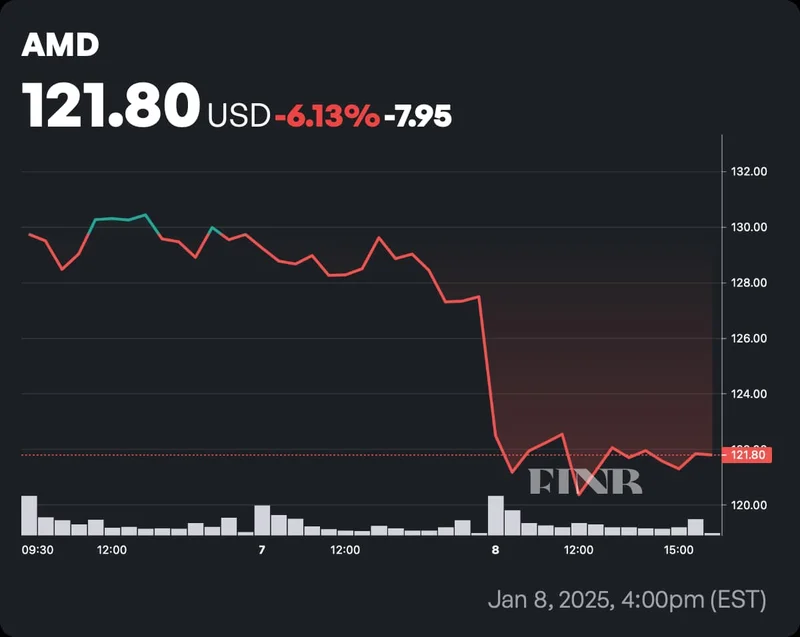
This is the core of AMD’s identity crisis. Its stock performance is no longer correlated with its success against Intel. The stock is up around 40% this year—to be more precise, 39.32% year-to-date—but that rally has nothing to do with Ryzen CPUs and everything to do with the AI boom and demand for its Instinct data center GPUs. The market has tethered AMD’s fate entirely to its ability to compete with the `nvda stock` juggernaut. Every percentage point of CPU share gained from Intel is being mentally cashed in by investors and immediately spent on the hope of clawing a few points of AI share from Nvidia.
The AI Distortion Field and a Geopolitical Wildcard
This single-minded focus on AI has created a distortion field around AMD’s valuation. The company’s recent financial performance is a case study in this phenomenon. Revenue growth has been impressive, accelerating for five consecutive quarters before hitting a snag in Q2 2025. The top line decelerated from 36% growth to 32%. The reason? An $800 million inventory-related charge stemming from U.S. restrictions on selling its high-end MI308 AI chips to China. Without that charge, growth would have continued its upward trajectory.
And this is the part of the analysis that I find genuinely problematic. That $800 million hit isn’t just a line item in a quarterly report; it’s a warning shot about the immense geopolitical risk now baked into AMD’s AI-centric valuation. The company’s future growth, as priced by the market, is heavily dependent on selling its most advanced silicon into a global AI arms race that is now being directly refereed—and restricted—by Washington D.C. What happens if those restrictions tighten? What happens when China, inevitably, cultivates its own domestic champions to fill the void?
This is where an analogy might be useful. The AI market is a massive, chaotic gold rush. Nvidia is selling the patented, industrial-grade mining equipment, and it's making an absolute fortune. AMD is also in the equipment business. The market is obsessed with whether AMD’s excavator can move as much dirt as Nvidia’s. But in its fixation, it’s ignoring the fact that AMD is also the primary supplier of durable canteens and reliable work boots (its CPUs) to half the miners in the camp—a steady, profitable, and growing business. The stock, however, is priced as if the entire company will live or die on the excavator business alone.
This leads to a baffling valuation. AMD is trading at less than 27 times next year’s projected earnings. Nvidia, the undisputed king with monstrous margins and faster growth, trades at 28 times forward earnings. The premium for being the dominant market leader is… almost nothing. This makes no logical sense unless you believe AMD is on the cusp of seizing a truly enormous piece of the AI pie from Nvidia. It’s a valuation that has priced in all of the optimism and none of the risk.
A Mispriced Narrative
My analysis suggests the market is fundamentally mispricing AMD by viewing it through a single, narrow lens. It’s not being valued as a diversified semiconductor powerhouse with a winning strategy in the CPU market and a high-risk, high-reward venture in AI. Instead, it’s being valued as a pure-play AI challenger, and a distant second at that. The steady, predictable cash flows from its CPU division are being treated as an afterthought.
The risk here is palpable. If AMD’s AI ambitions stall, if Nvidia’s moat proves too wide, or if geopolitical headwinds intensify, there is no valuation floor based on its CPU success to catch the falling stock. Wall Street has already forgotten about that battle. The consensus "Moderate Buy" rating and a modest 11% upside to the average price target feel less like a confident endorsement and more like a collective hedge. They see the potential, but they also see the shadow of Nvidia looming over everything. For investors, the question isn’t whether AMD can keep beating Intel. It’s whether a company can ever get a fair valuation when it’s forced to compete with a legend.
Tags: amd stock price
Rigetti's Quantum Breakthrough: What the Novera Deals Reveal & Why the Hype Is Just the Beginning
Next PostBitcoin's All-Time High: Defining the Metric and Analyzing the Price History
Related Articles